

As someone who has tracked the progression of online slots for years, I believe that truly creative games are rare https://esqueletoexplosivo2.net/. When Esqueleto Explosivo arrived onto the scene, it was a vibrant, wild, and utterly distinctive experience that established its own niche. Now, the sequel, Esqueleto Explosivo 2 Slot, has come, promising to enhance everything players enjoyed. To understand the artistic force behind this explosive follow-up, I gathered direct insights from the development team. This article reveals the creative approach, production obstacles, and creative choices that shaped this remarkable title, providing a rare glimpse into the studio’s process from initial concept to the final, fiery release.
The Core Concept: Evolving the Dynamic Formula
The initial Esqueleto Explosivo was a tremendous triumph, defined by its cascading wins, increasing multipliers, and a colorful Mexican Day of the Dead theme. The key difficulty for the developers wasn’t just creating a sequel, but evolving a popular formula without forfeiting its soul. The core directive was “more dynamism, more engagement, and more strategic depth.” They identified that while players adored the mounting tension of the original, they desired more ways for influence and bigger prospective peaks. This sparked the foundational idea of the Nitro Feature, a player-triggered bonus that serves as a strategic layer on top of the already unpredictable base game. The goal was to convert a purely responsive experience into one where players could, at key moments, feel a sense of agency, choosing when to inject pure chaos into the reels for potentially enormous rewards.
Another key aspect was enhancing the audiovisual spectacle while keeping clarity. The team recognized the sequel needed to appear instantly familiar yet visually superior. They improved the skeleton characters, providing them with more personality and smoother animations, and significantly enhanced the particle effects for explosions and cascades. The soundtrack and sound design received equal attention, with more multifaceted music that adapts to gameplay intensity and crisper, more striking sound effects for every tumble and win. This thorough attention to sensory detail assures that every spin is an engaging event, developing the original’s strong identity rather than merely replicating it.
Audio Design and Sonic Branding
In a slot as visually busy as Esqueleto Explosivo 2, sound design is essential in guiding the player’s emotional experience. The audio team defined their method as “orchestrated chaos.” The core soundtrack is an genuine, upbeat mariachi tune, but it’s dynamically built. During the base game, it holds a festive but steady tempo. As a cascade sequence starts and the multiplier rises, brass instruments expand, and the percussion becomes more noticeable, subtly amplifying the excitement without drowning the player. The most dramatic audio shifts are kept for the Nitro Feature and big wins, where the music attains a crescendo paired with a riot of celebratory sound effects.
Every single component has a special sonic signature. Different skeleton symbols have their own quick musical stings when part of a win. The cascade itself is followed by a satisfying “pop” and tumbling sound, while the multiplier growing is indicated by a clear, rising tonal cue. This thorough audio feedback is vital; it lets players to grasp precisely what is taking place on the reels if they only look at the screen. The team highlighted that great slot audio isn’t just background music; it’s a critical information delivery system and an feeling driver, making wins feel more real and the overall experience more unified and polished.
Visual Design: Bringing Vitality into the Undead Crew
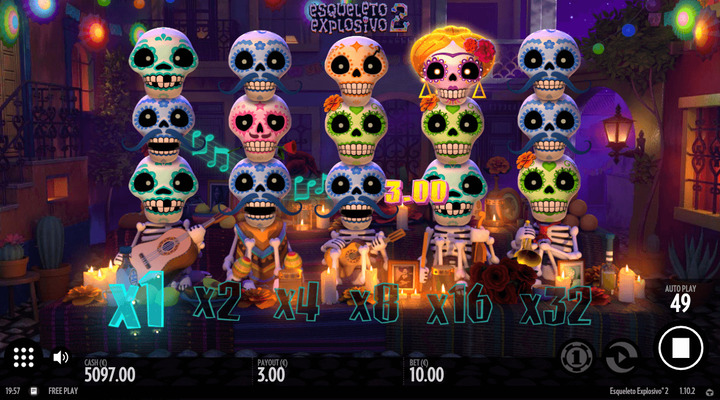
The visual approach of Esqueleto Explosivo 2 is deceptively simple. Attaining that ideal harmony between cartoonish charm and macabre whimsy demanded endless refinements. The designers explained that the skeletons had to be joyful and energetic, not frightening, with their festive skull patterns meticulously designed to be complex yet readable on tiny handheld devices. Every figure, from the main mariachi figure to the backup musicians, was provided a individual color set and accessory set to boost graphic appeal during the frenetic gameplay. The background was deepened, adding more scrolling depth effects and festive details like floating paper banners and twinkling lights, crafting a world that appears lively and vast.
Animation was where the real technical mastery shined. The team implemented a sophisticated skeletal animation system, enabling for fluid, bone-driven motion of the figures. This is most evident in the win animations; when a big win occurs, the whole team bursts into a synchronized dance that is both a reward and a show. The cascade mechanic itself is an animation wonder. Instead of symbols merely fading, they are fragmented with bespoke visual effects, and fresh icons fall into place with believable physics. The group spent many weeks fine-tuning the timing and “weight” of these cascades to make them feel satisfyingly chunky and powerful, a crucial factor in sustaining player engagement through long winning sequences.
Arithmetic and Mechanics: Creating the Nitro Feature
The mathematics model, or math behind the slot, is its unseen engine. For Esqueleto Explosivo 2, the critical task was integrating the fresh Nitro Feature without compromising the fine equilibrium of the existing cascade system. The core game maintains the beloved rising multiplier that grows with each consecutive cascade, resetting only on a unsuccessful spin. The designers examined large datasets from the first game to set a win frequency and risk level that seemed known but new. The Nitro Feature, unlocked by accumulating nitro symbols, was created as a regulated risk surge. When triggered, it ensures a cascade by swapping out low-value symbols, but its position is random, producing moments of intense excitement.
Adjusting this feature was a difficult undertaking. The crew performed thousands of simulations to guarantee the Nitro meter accumulated at a rate that seemed gratifying but not too regular, keeping its exclusive feel. They also had to adjust the power of the Nitro explosions to offer significant win potential without causing the base game to seem less appealing in contrast. The result is a slot with a dual-layer volatility: the gradual, escalating suspense of the core game punctuated by the explosive, high-stakes moments of the Nitro activation. This generates a more engaging flow, attracting players who like both long gaming sessions and the pursuit of exciting, bonus-triggered wins.
Technical Challenges and Efficiency Issues
Creating a slot with this level of constant animation and real-time particle effects posed significant technical hurdles. The primary challenge was ensuring seamless performance across all devices, from high-end desktops to older smartphones. The developers constructed a custom rendering pipeline to manage the hundreds of animated sprites and particles that can be on screen simultaneously during a large cascade. They deployed level-of-detail systems that automatically decrease visual complexity on less powerful devices without sacrificing the core game feel, preserving the explosive personality remained intact even on smaller screens.
Another major focus was the game’s memory management. With high-resolution assets for numerous symbols and animations, loading times were a worry. The team utilized advanced texture atlasing and asset streaming techniques to maintain the initial load quick and guarantee smooth transitions during gameplay. The sophisticated cascade and multiplier logic also demanded robust and bug-free code to address edge cases, like multiple Nitro triggers in a single spin. Rigorous testing across a vast matrix of devices and network conditions was crucial to provide the stable, polished experience players demand from a major studio release, where a single graphical glitch or lag spike can break immersion.
User Response and Recurring Development
The development of Esqueleto Explosivo 2 was not carried out in a vacuum. Early prototypes were shown to review groups consisting of both admirers of the original and new users. The designers closely monitored which features generated excitement and which resulted in confusion. Initial concepts for the Nitro meter, for example, were more complex, involving different nitro types. Feedback indicated this was overwhelming, leading to the refined, single-meter system seen in the finished game. Similarly, early iterations had a more muted color palette, but testers consistently commented it missed the energy of the original, steering the artists back toward more vivid, more intense colors.
This cyclical process extended to the game’s pacing. Data from game tests revealed that while users loved the big multiplier jumps, there could be long periods without a Nitro trigger. The group modified the symbol layout and meter fill frequency to create a more uniform flow of smaller thrills between the major feature events. This gamer-oriented approach was crucial; it guaranteed the game was being developed not just by design documents, but by genuine human reactions and engagement trends, resulting in a finished product that appears optimized for fun rather than just abstract systems.